
Under the Swachh Bharat Mission–Urban 2.0, the Thiruvananthapuram Municipal Corporation has deployed the G-Spider Robot, an AI-powered canal-cleaning system designed to enable safe, precise, and human-free sanitation operations in high-risk areas.
In a significant move to eliminate manual scavenging and enhance the safety of sanitation workers engaged in waste removal in hazardous and inaccessible locations, the Thiruvananthapuram Municipal Corporation has introduced the G-Spider Robot at the Amayizhanchan Canal near the railway station premises at Thampanoor.
The G-Spider Robot, an advanced AI-powered canal-cleaning system, has been deployed to manage cleaning operations in environments where human entry is unsafe or impractical.
Addressing Challenges in Canal Cleaning
The Amayizhanchan Canal – especially the covered stretch beneath Thampanoor Railway Station – presents multiple operational challenges that make conventional cleaning methods difficult.
These challenges include restricted vertical clearance, continuous water flow, confined working conditions, and the absence of safe entry points for sanitation workers.
Due to these conditions, routine maintenance and cleaning of the canal have remained extremely difficult through traditional methods.
The deployment of the G-Spider Robot aims to overcome these challenges by introducing a robotic system capable of operating efficiently in such complex environments without requiring human entry.
Also Read: Kerala Installs G-Gaiter Robotic Gait Trainer at Noolpuzha FHC
Robotic Technology for Safer Sanitation
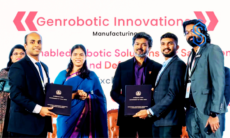
To address these limitations, the AI-powered G-Spider Robot canal-cleaning system was commissioned by M B Rajesh, Minister for Local Self-Governments.
The initiative is the result of a collaborative effort between the Thiruvananthapuram Municipal Corporation and Technopark-based Genrobotic Innovations, the developers of the well-known robotic scavenger ‘Bandicoot’.
Officials highlighted that the introduction of the G-Spider Robot would eliminate the need for workers to enter hazardous and unhygienic environments during canal maintenance.
They described the deployment as a significant step toward improving operational efficiency while strengthening safety standards in urban waste management.
Advanced Engineering Behind the G-Spider Robot
Developed by Genrobotic Innovations, the G-Spider Robot is engineered to function in complex canal systems that are otherwise difficult for humans to access.
The robotic platform is built using a Cable-Driven Parallel Robotics (CDPR) architecture and is powered by AI-enabled vision systems and sensor intelligence.
These technologies allow the G-Spider Robot to detect, assess, and remove accumulated waste with precision. Using advanced machine vision capabilities, the robot can autonomously identify different types of waste, evaluate flow conditions, and adapt to structural constraints in real time.
The G-Spider Robot features a five-degrees-of-freedom robotic mechanism equipped with a biomimetic claw-type grabber. This system ensures accurate positioning and secure handling of irregular and mixed debris commonly found in urban canals.
Once collected, the extracted waste is directly transferred into designated collection vehicles. This creates a completely hands-free canal-cleaning process, covering the entire workflow – from waste detection and retrieval to safe disposal.
Also Read: Bandicoot Mobility+ Rolls Out Across Gujarat, Deploys Robots Across ULBs
Enhancing Safety and Urban Sanitation
The deployment of the G-Spider Robot by the Thiruvananthapuram Municipal Corporation represents a transformative step toward technology-driven urban sanitation systems.
By automating canal cleaning operations, the G-Spider Robot significantly reduces the exposure of sanitation workers to toxic gases, contaminated water, and hazardous waste materials.
The system has been designed to function effectively even during high water levels and continuous flow conditions. This capability allows the G-Spider Robot to maintain uninterrupted canal maintenance operations and ensure consistent sanitation standards across urban waterways.
In addition to handling general waste, the G-Spider Robot can safely extract mixed and hazardous debris such as plastics, sharp materials, and other harmful substances. This improves overall cleanliness while reducing environmental risks within drainage networks.
Regular and systematic cleaning enabled by the G-Spider Robot also improves drainage efficiency. By preventing blockages and ensuring smooth water flow, the system contributes to reducing the risk of urban flooding while supporting the development of a cleaner and safer city environment.
A Model for Technology-Driven Urban Infrastructure
The deployment of the G-Spider Robot marks a decisive transition toward safe, mechanised, and technology-enabled canal maintenance systems.
By removing the need for sanitation workers to enter dangerous environments, the initiative strengthens worker safety while improving the efficiency of waste management operations.
Officials noted that the G-Spider Robot has the potential to serve as a scalable and replicable model for other high-risk canals and drainage networks across the state.